
Himalayan Balsam
The River Hun flows west to east through the parish, bordering Broadwater Road for part of its journey. Around 2009, a pretty pink flower appeared along its banks—especially around the Norfolk Ornithologists' Association hide on Redwell Marsh. But beauty can be deceptive.
A Pretty but Invasive Problem
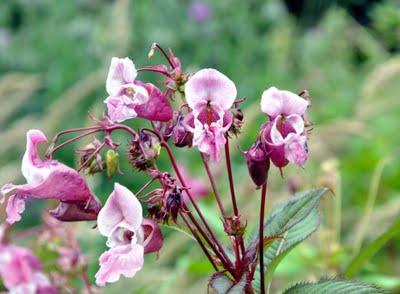
Himalayan Balsam flowers
Impatiens glandulifera, known by many colorful common names—Policeman's Helmet, Bobby Tops, Copper Tops, Gnome's Hatstand and Kiss-me-on-the-mountain—is very invasive. It typically grows to 1 to 2 meters high, with soft green or red-tinged stems and lanceolate leaves 5 to 23 cm long. The crushed foliage has a strong musty smell.
The flowers are distinctive—pink, with a hooded shape, 3 to 4 cm tall and 2 cm broad. The flower shape has indeed been compared to a policeman's helmet, giving rise to the common name.
Explosive Reproduction
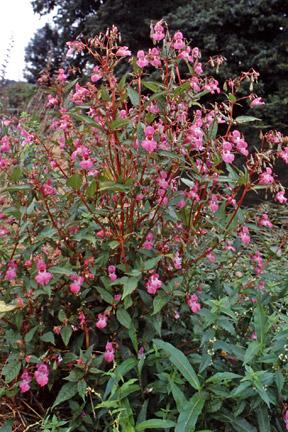
Himalayan Balsam plant
After flowering between June and October, the plant forms seed pods 2 to 3 cm long, which explode when disturbed, scattering seeds up to 7 meters away. The name "Impatiens" (meaning "impatient") refers precisely to this aggressive method of dispersal.
Himalayan Balsam was introduced to the UK in 1839 at the same time as Giant Hogweed and Japanese Knotweed. Though sometimes cultivated for its attractive flowers, it has become widely established and invasive in the British Isles and beyond.
Outcompeting Native Flora
The aggressive seed dispersal, coupled with high nectar production which attracts pollinators, allows Himalayan Balsam to outcompete native plants. This invasive species is a significant concern for habitat management along rivers and wetlands, including our own River Hun.