
An Old World Woodpecker in the Village
On 7th May, 2017 a couple of residents living in Westgate were enjoying Sunday lunch when a small, cryptically-plumed bird landed on their lawn. It was an Eurasian Wryneck—a member of the Old World woodpecker family.
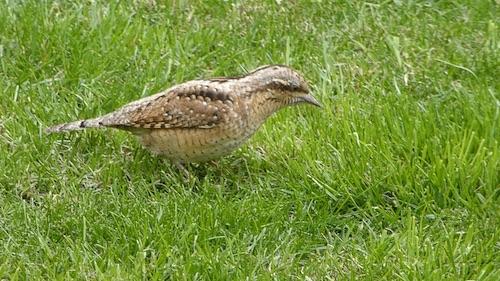
Eurasian Wryneck in Holme-next-the-Sea, May 7th, 2017
On 7th May, 2017 a couple of residents living in Westgate were enjoying Sunday lunch in their dining room when a small sparrow-sized, but 'different', bird showing very cryptic (camouflage) plumage landed on the lawn outside the window. It was then seen busily feeding in the garden for the next two hours.
The residents, being birders for many years, recognised it as an Eurasian Wryneck (Jynx torquilla).
This strange looking little bird is a member of the Old World woodpecker family. Just like the true woodpeckers the Wryneck has a relatively large head and also a long tongue which they use to pull out their insect prey - often ants. You can see in the photo below that the bird has two toes pointing forward and two backwards - a feature shared with the other woodpeckers and known as zygodactyl feet.
The bird gets its English name from its ability to turn the head almost 180 degrees.
They are uncommon migrant visitors to this country being seen more in the Autumn and less likely in Spring when the few seen mostly turn up in May. This bird may well have flown to Norfolk from Africa just south of the Sahara desert!
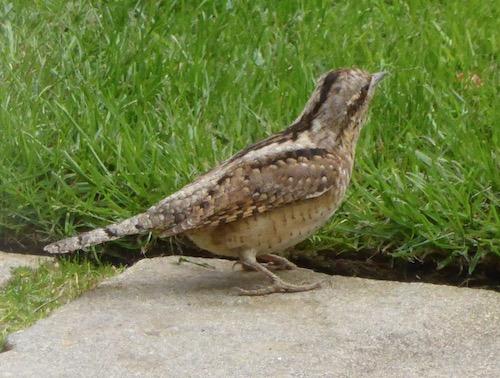
Eurasian Wryneck showing two toes pointing forward and two backwards